Web Development
Website Development Riyadh | Custom Web Development
Adonix Team • Published: 31 July 2026 • Last updated: 4 November 2026 • 8 min read

Riyadh is the administrative and financial heart of Saudi Arabia, home to enterprise headquarters, government-linked entities, and a fast-growing base of ambitious startups. As these organizations mature, their websites need to do more than look good — they need to function as real platforms: fast, secure, integrated with business systems, and capable of handling growth without breaking down.
This is where website development becomes distinct from website design. Design shapes the experience; development builds the engine underneath it. This guide explains what website development in Riyadh actually involves, why it matters for organizations at this stage, and how to evaluate a development partner capable of delivering it.
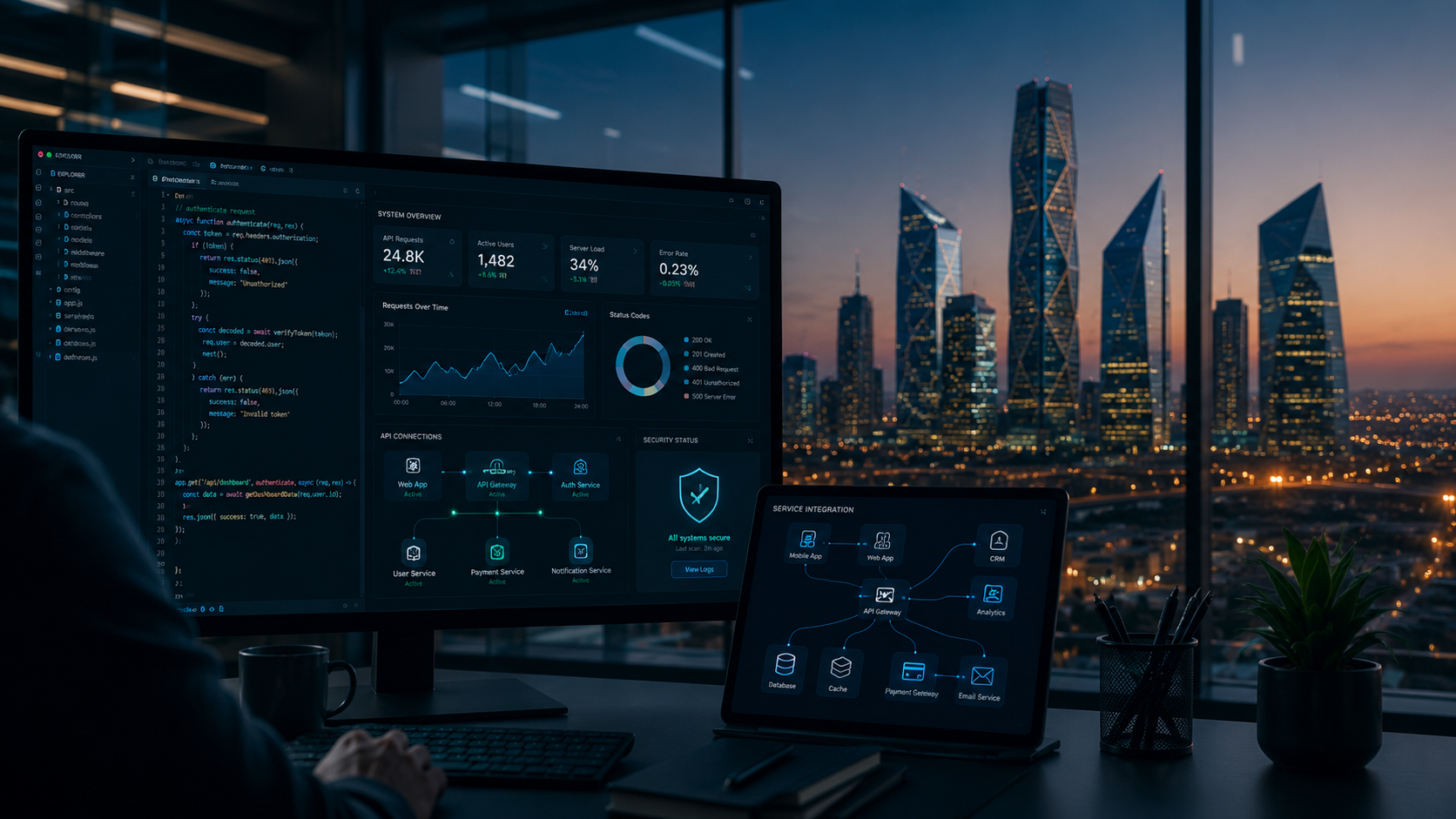
Website development is the technical process of building a website's underlying functionality — the code, database, integrations, hosting environment, and security architecture that make a website actually work. It includes front-end development (what users interact with) and back-end development (the server, database, and logic layer that powers it).
Where design determines how a site looks and feels, development determines how it performs: how fast it loads, how securely it handles data, how well it integrates with other systems, and how easily it can grow as the business grows.
Riyadh's business environment includes some of the Kingdom's largest enterprises, most active startups, and organizations closely tied to national digital transformation efforts. This creates a specific set of technical expectations:
A financial services firm based in King Abdullah Financial District may need a client portal connected securely to internal systems, with strict uptime and data-handling requirements. A platform built without proper backend architecture and security planning risks both performance issues and compliance concerns — regardless of how polished the front-end design looks.
A fast-scaling Riyadh startup in retail or logistics may launch with a simple website, then need to add ecommerce, inventory integration, or a customer portal within a year. If the original platform wasn't built on a scalable architecture, that growth triggers a costly rebuild rather than a straightforward expansion — a common and avoidable setback.
In both cases, the businesses may have strong offerings and clear growth plans — but the technical foundation of the website determines whether that growth is smooth or disruptive.
Riyadh's role as a national hub for enterprise activity and digital transformation initiatives means development standards here are often shaped by organizations with serious technical requirements — banks, large retailers, logistics firms, and government-linked entities. This raises the baseline expectation for what "professional development" means: not just a working website, but one built with performance, security, and integration in mind from day one.
As more of the Kingdom's economy moves online in line with Vision 2030 priorities, Riyadh-based organizations increasingly need platforms that can support ecommerce, multilingual service delivery, and integration with digital payment and government-linked systems.
What is website development?
Website development is the technical process of building a website's functionality — front-end, back-end, database, and integrations — so it performs reliably, securely, and at scale.
How much does website development cost in Riyadh?
Costs depend heavily on complexity: integrations, custom functionality, security requirements, and scale all affect the investment required, with enterprise platforms costing more than simple informational sites.
How is website development different from website design?
Design focuses on the visual layout and user experience; development focuses on the technical architecture and functionality that make the site actually work.
How long does a website development project take?
Timelines vary based on complexity and integrations, but enterprise-level projects typically move through discovery, architecture planning, build, and testing phases before launch.
Do I need a scalable website architecture if I'm a small business today?
If you expect to grow — adding services, ecommerce, or new markets — planning for scalability early avoids a costly rebuild later.
What integrations are common for Riyadh businesses?
CRM systems, payment gateways, booking platforms, ERP systems, and analytics tools are among the most common integration needs.
Is security really necessary for a business website?
Yes — any website handling customer data, payments, or business-critical information should be built with security considered at the architecture level.
Can website development improve site speed and SEO?
Yes — clean code, efficient architecture, and proper hosting configuration directly influence load times, which affect both user experience and search rankings.
Should my website support both Arabic and English at a technical level?
For most Riyadh businesses serving both local and international audiences, yes — native bilingual support avoids the limitations of a simple translation layer.
What should I look for in a Riyadh web development company?
Look for demonstrated technical capability (not just design portfolio), experience with relevant integrations, a clear approach to security and scalability, and transparent communication throughout the project.
As Riyadh continues to grow as a center for enterprise activity and digital transformation, the businesses that thrive online are the ones whose websites are built to perform — not just to look presentable. Website development is where that performance is engineered: in the architecture, the integrations, and the security decisions made before a single visitor ever arrives.
Adonix Digital builds websites for Riyadh businesses engineered for real performance — secure, scalable, and integrated with the systems your business already relies on. If you're planning a new platform or evaluating whether your current site can support your next stage of growth, our team is glad to talk through your requirements.
Enterprise Development with Adonix Digital: We engineer modern corporate portals and custom web applications for Riyadh enterprises. Explore our web development services, review our guide on hiring a web development company in Saudi Arabia, or learn about our digital marketing and web pricing benchmarks.
We build AI-driven digital operations engines to help ambitious businesses scale.