Marketing
Google Ads vs Meta Ads in Saudi Arabia: Which Delivers Higher ROI in 2026?
Adonix Team • Published: 3 October 2026 • Last updated: 4 November 2026 • 9 min read
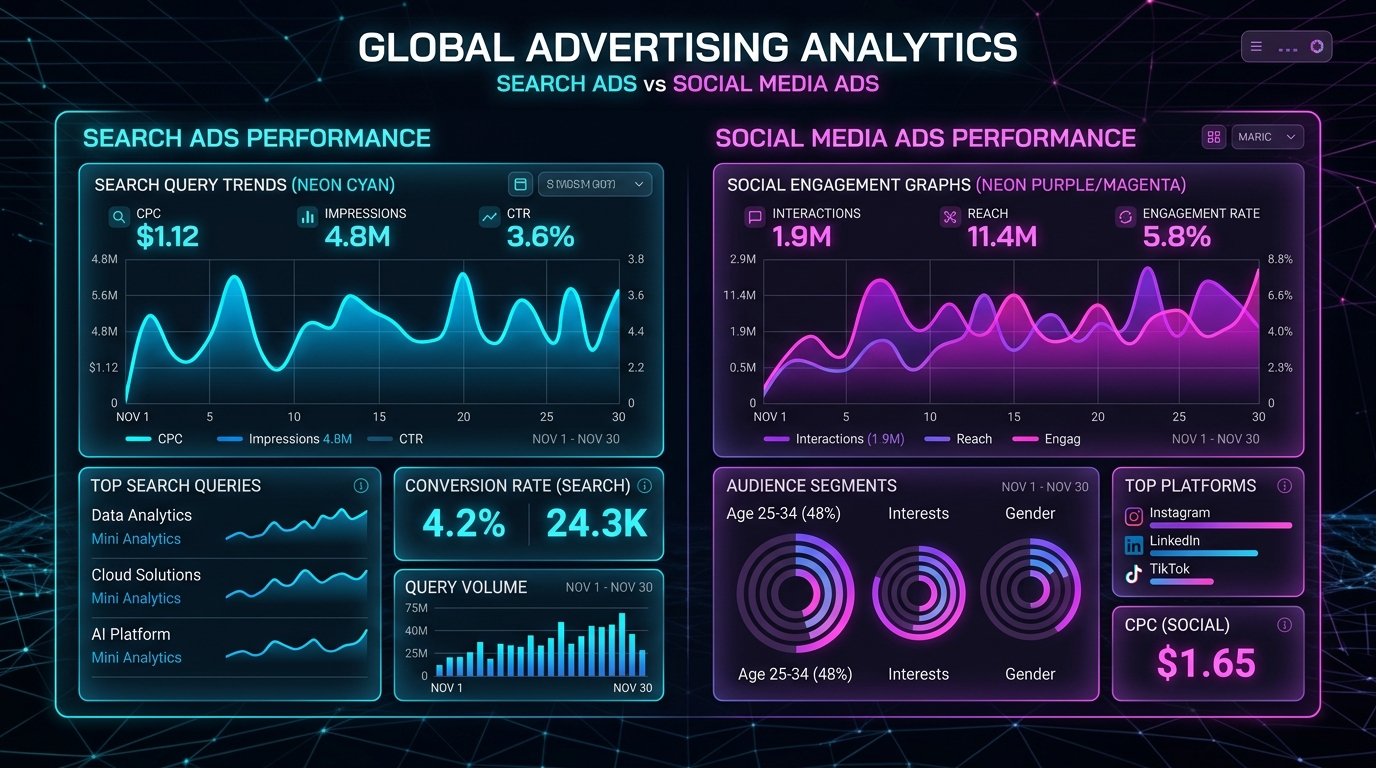
Which platform delivers better ROI: Google Ads or Meta Ads in Saudi Arabia? The answer depends strictly on commercial intent: Google Ads is the premier engine for capturing existing demand from buyers actively searching for solutions, while Meta Ads (Instagram, Facebook, and WhatsApp) is the undisputed powerhouse for generating new demand and visual brand awareness across the Kingdom.
Every commercial director, founder, and marketing executive operating in Saudi Arabia faces the exact same budget allocation dilemma: should you deploy your paid advertising budget into Google Search and Performance Max, or concentrate capital into Meta's advertising ecosystem? With advertising costs (CPC and CPM) in the GCC ranking among the highest in the developing world due to intense competition and tremendous consumer purchasing power, misallocating your ad spend can quickly erode profit margins.
In 2026, the discussion is no longer about choosing one platform over the other in isolation. Winning in the Saudi market requires understanding the distinct psychology of local buyers on both channels and orchestrating them into a cohesive, high-conversion growth machine. This deep-dive comparison examines cost benchmarks, target audience behaviors, B2B vs B2C dynamics, and the unified full-funnel strategy needed for sustainable ROI.
To evaluate these platforms accurately, you must first recognize the fundamental difference in how prospective customers interact with them:
When an operations manager in Riyadh searches for "commercial solar panel suppliers Riyadh" or a homeowner in Jeddah searches for "emergency AC repair near me," they already have a defined problem, an active intent to purchase, and a sense of urgency. Google Ads places your business directly in their line of sight at the exact moment of commercial consideration. The user is actively seeking you out.
Users do not log into Instagram or Facebook to buy enterprise software or book industrial logistics. They are scrolling through curated feeds, engaging with friends, following influencers, and consuming media. Meta Ads is an interruption-based, discovery engine. Its strength lies in using captivating video and visual creative to demonstrate a problem the user did not know they had, introducing your solution, and building aspirational brand desire.
Your business model plays a decisive role in determining which advertising channel should anchor your acquisition strategy:
For B2B companies — whether selling industrial equipment, SaaS platforms, or corporate advisory services — Google Search Ads consistently delivers the highest lead quality. In Saudi Arabia, business procurement officers, managing directors, and project engineers rarely purchase from social media impulse clicks. They conduct structured search inquiries. However, savvy B2B brands leverage Meta Ads in a secondary role: retargeting past website visitors on Instagram to keep the brand top-of-mind during protracted 3- to 9-month sales cycles. Read more on how this dynamic operates in our analysis of B2B vs B2C lead generation strategies.
For B2C brands — spanning luxury retail, hospitality, real estate developments, aesthetic clinics, and e-commerce — Meta Ads is virtually mandatory. The Saudi populace represents one of the world's most engaged social media demographics. Visual storytelling, video showcases of properties or medical transformations, and direct Click-to-WhatsApp ad formats yield massive inquiry volumes at highly competitive customer acquisition costs.
A common mistake made by newcomers to the Saudi market is expecting Western or South Asian cost benchmarks. The Saudi market is characterized by a concentrated population with exceptionally high disposable income, creating aggressive ad auctions:
| Dimension | Google Ads (Search & PMax) | Meta Ads (Instagram, FB, WhatsApp) |
|---|---|---|
| User Mindset | Active problem solving; high immediate purchase intent | Passive discovery, entertainment, and social connection |
| Best Suited For | High-ticket B2B, urgent consumer services, known product categories | Visual B2C, real estate, lifestyle products, brand awareness |
| Primary Target Signals | Search keywords, location, in-market intent audiences | Lookalikes, behavioral signals, interest clusters, Advantage+ AI |
| Conversion Friction | Low (user is seeking immediate contact or quotation) | Medium-High (requires compelling creative hook and swift follow-up) |
| Average Lead Velocity | Fast sales cycle; ready to transact or request quote | Requires nurturing, instant WhatsApp response, or automated retargeting |
Treating Google and Meta as competing silos is the single biggest cause of wasted advertising capital. In 2026, the most profitable companies in Saudi Arabia run an integrated, full-funnel machine:
This closed-loop system drives compounding returns. Google captures the demand created by Meta, while Meta nurtures the leads generated by Google.
Which platform delivers higher ROI in Saudi Arabia: Google Ads or Meta Ads?
Google Ads typically delivers higher immediate ROI for B2B and emergency services because searchers already have high purchase intent. Meta Ads delivers superior ROI for visual B2C products, real estate, and lifestyle brands by generating massive awareness and cost-effective leads.
Are advertising costs higher in Saudi Arabia compared to other markets?
Yes. Due to exceptionally high consumer purchasing power and a competitive business landscape under Vision 2030, CPC and CPM rates in Saudi Arabia and the GCC are substantially higher than in most developing markets, requiring precise targeting and localized creative.
Should B2B companies advertise on Meta platforms in Saudi Arabia?
Yes, primarily for retargeting and Account-Based Marketing (ABM) brand building. While Google captures the initial intent, keeping your brand in front of Saudi corporate decision-makers on Instagram during long buying cycles dramatically improves closing rates.
Why is Click-to-WhatsApp advertising so effective in the Kingdom?
WhatsApp is the ubiquitous channel for both personal and business communication in Saudi Arabia. Providing an immediate, friction-free messaging link converts hesitant mobile prospects far more effectively than traditional multi-step web forms.
What is the best way to combine Google Ads and Meta Ads?
Use Meta Ads to build awareness and generate demand across targeted audiences, use Google Search Ads to capture users searching for your brand or category, and use Meta retargeting to bring undecided prospects back to close.
Choosing between Google Ads and Meta Ads is a false dichotomy. In Saudi Arabia's sophisticated digital economy, the businesses achieving exponential growth are those that deploy both channels harmoniously — leveraging Meta to spark desire and building an unshakeable presence on Google to capture every transaction. When backed by intelligent CRM integration and rapid lead response, this unified system produces unmatched returns.
A Note from Adonix Digital: Adonix Digital engineers full-funnel paid advertising systems across Google and Meta, complete with custom landing pages, AI bidding optimization, and WhatsApp automation built for the Saudi market. If you are ready to maximize your advertising return on investment, explore our performance advertising services or connect with our strategy team for a tailored campaign audit.
We build AI-driven digital operations engines to help ambitious businesses scale.